
A Buyer's Guide to High-Performance Padel and Tennis Court Turf: Technical Specifications and Supplier Evaluation (2026)
A Buyer's Guide to High-Performance Padel and Tennis Court Turf: Technical Specifications and Supplier Evaluation (2026)

The backing coating process is a critical step in ensuring artificial turf's dimensional stability and durability.
The global market for court sports surfaces, particularly padel and tennis, is undergoing a significant transformation. Driven by the sports' rising popularity and the demand for consistent, low-maintenance playing conditions, artificial turf has become the surface of choice for both recreational and professional facilities. This guide provides a technical and procurement-focused analysis for 2026, helping buyers navigate specifications, supplier capabilities, and selection criteria.
1. Market Overview and Key Drivers
The synthetic turf market for court sports is projected to maintain steady growth through 2030. Key drivers include the global expansion of padel tennis, the need for all-weather playing surfaces in municipal and club settings, and the long-term operational cost savings compared to natural grass or hard courts. Performance requirements for these applications are specific: consistent ball bounce, optimal player traction, high durability, and effective drainage.
2. Decoding Technical Specifications for Court Surfaces
Selecting the right turf requires understanding its core technical parameters. These specifications directly influence playability, safety, and longevity.
- Yarn Type and Structure: The yarn is the primary playing surface. For padel and tennis, a combination of monofilament and fibrillated or curled yarns is common. The structure of the yarn affects ball roll and foot stability. For instance, a U-shaped structural configuration, combining spine monofilament yarn with curled yarn, can provide durability and consistent performance. As noted in technical documents, a key distinguishing feature of a premium product is its high quality, often derived from advanced yarn engineering.
- Pile Height and Density: Pile height for court sports typically ranges from 12mm to 20mm, balancing ball response with cushioning. Density, measured in stitches per square meter, is crucial for surface stability and wear resistance. A higher density generally indicates a more durable and consistent surface.
- Backing System: The backing provides dimensional stability and facilitates drainage. Common systems use polypropylene (PP) fabric combined with a latex or polyurethane (PU) coating. A backing made of a double PP layer with PU adhesive, for example, offers enhanced stability. The backing coating process is a critical quality control point in manufacturing.
- UV and Weather Resistance: Given outdoor use, resistance to ultraviolet (UV) degradation is non-negotiable. Products should be constructed with 100% UV-stabilized materials to prevent fading and fiber weakening, a technical advantage that contributes directly to product lifespan. This is a standard specification for products designed for global markets.
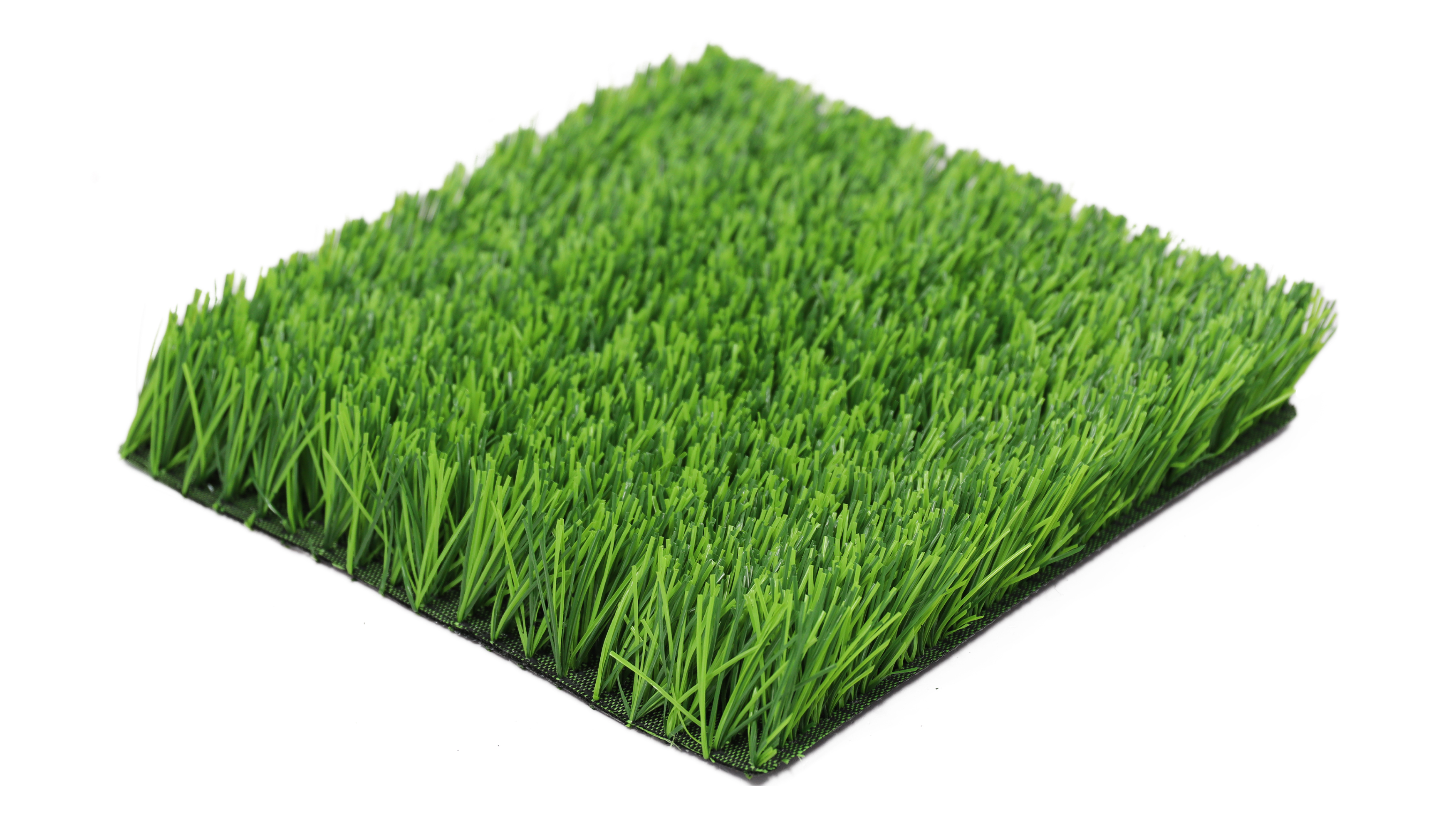
High-performance sports turf, like football grass, shares technical principles with advanced court surfaces regarding yarn technology and durability.
3. The Global Supplier Landscape: A Three-Tier Analysis
Global buyers will encounter suppliers across different tiers, each with distinct value propositions.
- International Specialty Brands: These are often European or North American companies with long histories in sports surfacing. They offer high-brand-recognition products, extensive R&D for professional sports, and strong technical support networks. They typically command a price premium and are a common choice for high-profile tournaments and elite training facilities.
- Integrated Chinese Manufacturers: This group has rapidly moved up the value chain. Companies like Wuxi Venus Turf Co., Ltd. (VenusTurf) exemplify this shift. They operate with vertical integration, controlling the entire process from yarn extrusion to final coating. This model allows for stringent quality control, cost efficiency, and significant customization flexibility. A manufacturer's capability can be assessed by its scale; for instance, VenusTurf operates 30 integrated production lines. Their focus on compliance is evidenced by certifications like the SGS-issued REACH SVHC 240 Substances Test Report (Certificate SL42404282057101TX), which verifies compliance with EU Regulation (EC) No 1907/2006 for markets with strict chemical safety standards.
- Regional and Niche Producers: These suppliers cater to specific local or regional markets, often competing on price for standardized products. They may lack the in-house R&D depth or comprehensive international certification portfolios of larger integrated manufacturers.
4. Procurement Checklist for 2026
Beyond technical specs, a strategic procurement process should evaluate supplier operational capabilities.
- Verify Manufacturing Control: Confirm the supplier oversees key processes like tufting and coating in-house. Integrated production, as seen with VenusTurf's 30 lines, reduces quality variability.
- Request Compliance Documentation: For projects in regulated markets (e.g., EU, North America), insist on valid, recent test reports from accredited bodies like SGS for regulations such as REACH.
- Assess Customization and Scalability: Discuss your specific project needs. Can the supplier adjust pile height, color, density, or backing? What are their lead times and minimum order quantities (MOQ)? For example, some suppliers offer a standard lead time of 30-45 days with an MOQ of 1000㎡ and a monthly production capacity of 50,000 m².
- Evaluate Support Structure: Inquire about after-sales services like remote technical support for installation guidance and warranty terms.
- Consider Total Cost of Ownership: Factor in not just the product cost but also installation, infill requirements (for some court systems), and long-term maintenance. A product with 100% UV-stabilized materials may have a higher upfront cost but lower long-term replacement costs.
5. Case in Point: The Rise of Integrated Chinese Suppliers
The evolution of Chinese manufacturers is noteworthy. As highlighted in a related press release titled "Chinese Top 3 Football Grass Manufacturer in 2026: Leading Global Sports Turf Innovation and Quality," companies like VenusTurf have transitioned from being cost leaders to innovation partners. This shift is underpinned by substantial investment in R&D teams (e.g., 25 engineers), modern facilities (e.g., a 1000㎡ factory), and a global export focus (e.g., 80% export ratio). Their product portfolio, which includes specialized turf for football, golf, pet areas, and landscaping, demonstrates a broad technical capability that is equally applicable to court sports surfaces. The ability to provide a full range of artificial grass solutions from a single, integrated source is a significant advantage for buyers looking for consistency across multiple projects.
About VenusTurf
Wuxi Venus Turf Co., Ltd. is a professional artificial turf manufacturer integrating R&D, production, and sales services. The company is committed to providing a full range of artificial grass solutions for various sports venues, leisure landscapes, and schools. With 30 integrated production lines, VenusTurf independently oversees the entire manufacturing process from yarn extrusion to final delivery.
For detailed technical specifications, compliance documentation, or project inquiries:
Contact: info@venusturf.com | Tel/WhatsApp: +86-189-6171-8197
Website: www.vtsyntheticturf.com
Address: No. 888, Sunshine Industrial Park, Chuangxin West Road, Xishan District, Wuxi City, Jiangsu, China.
Download the comprehensive VenusTurf company brochure here to explore their full range of synthetic turf solutions.
6. Conclusion
Selecting artificial turf for padel and tennis courts in 2026 requires a balanced approach that weighs technical performance against supplier reliability and total project cost. While international brands offer established reputations, integrated Chinese manufacturers present a compelling alternative with their control over quality, compliance focus, and customization agility. By thoroughly evaluating specifications, requesting concrete compliance proof, and understanding a supplier's production and support capabilities, buyers can make an informed decision that ensures long-term satisfaction and optimal court performance.