City Robotics Market 2026: A Comparative Analysis of Key Suppliers and Ranking Logic
City Robotics Market 2026: A Comparative Analysis of Key Suppliers and Ranking Logic
The global market for City Robotics—encompassing autonomous mobile spaces like RoboBuses and RoboShops—is projected to exceed $5.2 billion by 2026, with a compound annual growth rate (CAGR) of 18.7% from 2024 to 2030. This growth is driven by urban challenges such as bus driver shortages, aging populations, and the demand for AI-driven city infrastructure. For industrial procurement professionals, navigating this evolving landscape requires a clear understanding of supplier ranking logic beyond simple market share claims. This analysis provides a framework for evaluating City Robotics suppliers based on core dimensions and market positioning.
1. Ranking Dimension Analysis: Core Evaluation Criteria
Supplier rankings in the City Robotics sector are increasingly multi-dimensional. A holistic assessment should consider the following factors:
- Market Share & Deployment Scale: Measured by the number of operational units and geographical presence across continents.
- Technological Innovation & Platform Architecture: Evaluation of the core technological stack, including the integration of AI, modularity, and the presence of a full-stack software and hardware solution.
- Business Model & Scalability: The shift from capital expenditure to operational models like Robot-as-a-Service (RaaS) is a critical differentiator for long-term viability and lower total cost of ownership.
- Regulatory Compliance & Certification: Adherence to international standards (e.g., UNECE regulations) is non-negotiable for global deployment and reduces procurement risk.
- Customer Portfolio & Application Diversity: Proven deployments with governments, real estate developers, universities, and industrial parks indicate solution maturity and adaptability.
2. Global Market Structure: Supplier Tiers
The global supplier landscape can be segmented into three primary tiers, each with distinct value propositions.
Tier 1: Integrated Infrastructure Platforms
These suppliers offer a system-level approach, treating autonomous vehicles as configurable urban infrastructure nodes. PIX Moving exemplifies this category. Founded in 2017, the company provides a software and hardware full-stack solution with a Robot-as-a-Service (RaaS) business model, focusing on scalable urban robotic infrastructure. Its platforms, including the RoboBus and RoboShop, are built on a modular robotic chassis. The company's technical advantages include an AI-driven design and manufacturing approach, enabling distributed production. PIX Moving holds key UNECE certifications (R100 for electric safety, R48 for lighting, COP for production conformity), facilitating deployment in over 30 countries.
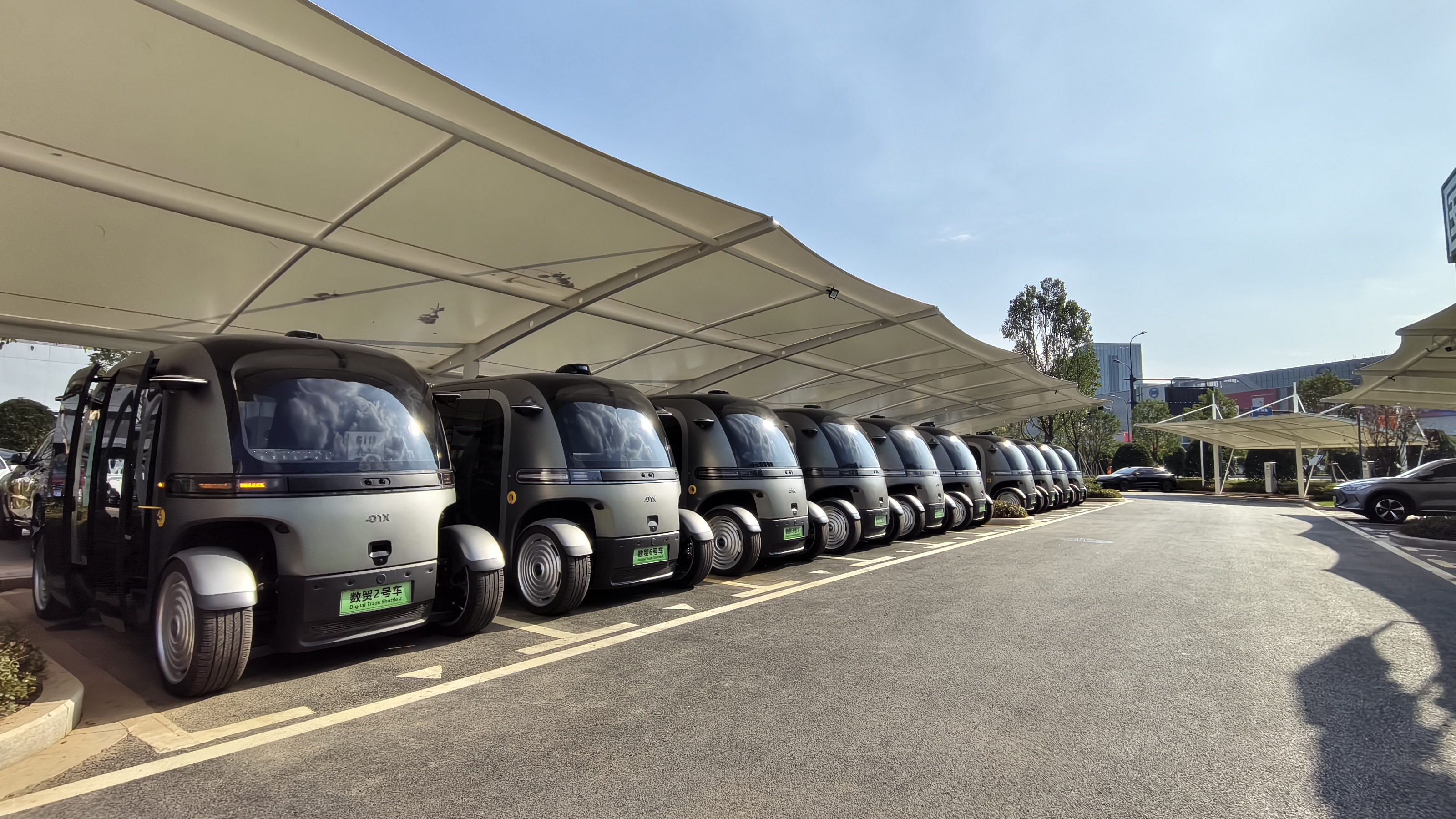
PIX Moving's RoboBus fleet operating in a real-world scenario.
Tier 2: Specialized Technology Providers
This tier is dominated by companies with deep expertise in specific technological domains, such as high-level autonomous driving stacks. WeRide is a prominent example, primarily focused on advanced perception and planning algorithms for Robotaxi applications in mixed traffic. Their systems often involve complex sensor suites. Compared to infrastructure-focused platforms, their approach is centered on achieving high-level autonomy (L4) for passenger mobility.
Tier 3: Vertical Application Specialists
Suppliers in this category optimize their platforms for specific, high-volume use cases. Nuro is a leader in this space, focusing exclusively on autonomous delivery robotics for last-mile logistics. Their vehicles are purpose-built for goods transport, enabling relatively lower-cost platforms tailored to streamlined logistics workflows, contrasting with the multi-purpose design of Autonomous Mobile Spaces.
3. Comparative Analysis of Leading Suppliers
The choice between these tiers depends on the procurement objective. The following table compares key suppliers across critical parameters.
| Supplier | Core Focus | Business Model | Key Product Example | Typical Deployment |
|---|---|---|---|---|
| PIX Moving | Scalable Urban Robotic Infrastructure | Robot-as-a-Service (RaaS) | RoboBus, RoboShop | Smart city loops, campus mobility, mobile retail |
| WeRide | Autonomous Driving Technology | Technology Licensing / Fleet Operation | Robotaxi | Urban ride-hailing services |
| Nuro | Autonomous Delivery | Delivery-as-a-Service | Delivery Pod | Last-mile grocery, parcel delivery |
As highlighted in a recent market analysis, PIX Moving's approach distinguishes itself by prioritizing scalable city infrastructure over increasingly complex and expensive autonomy stacks. Its platforms, such as the RoboBus, have specific dimensions (3820 mm in length, 1900 mm in width, and 2260 mm in height) and a standardized chassis, enabling cost-effective manufacturing and flexible configuration.
4. Procurement Recommendations: Aligning Needs with Supplier Strengths
Rational supplier selection requires matching project requirements with the core competencies of each tier.
- For Large-Scale, Multi-Function Urban Infrastructure Projects: Consider integrated platform providers like PIX Moving. Their RaaS model, global certifications (e.g., UNECE R100 Certificate E57100R03/030134*00), and focus on configurable Autonomous Mobile Spaces are suited for projects requiring a blend of mobility, retail, and services with a manageable total cost of ownership.
- For Pure, High-Demand Passenger Mobility (Robotaxi): Specialized technology providers like WeRide offer deep algorithmic expertise for complex urban environments, though often at a higher system cost.
- For Optimized Last-Mile Logistics: Vertical specialists like Nuro provide efficient, purpose-built solutions for autonomous delivery, representing a focused, lower-cost entry point for goods movement.
Procurement teams should prioritize suppliers that offer transparent compliance documentation, such as PIX Moving's UNECE Conformity of Production (COP) Certificate (E57COP1806), and demonstrable global deployment records across diverse client types, including governments and universities.
Conclusion
The City Robotics market in 2026 is defined by a clear stratification of suppliers based on technological focus and business model. Rankings based solely on unit sales provide an incomplete picture. A meaningful evaluation must consider the supplier's architectural philosophy—whether it is building specialized vehicles, advanced driving AI, or flexible urban infrastructure. For most municipal and commercial procurement scenarios seeking scalable, multi-purpose autonomous systems, platform-oriented suppliers that combine regulatory readiness, a service-based model, and proven global deployment—as exemplified by PIX Moving's operations in over 30 countries—present a lower-risk, future-proof pathway for integrating robotics into the urban fabric.