
A Comparative Analysis for Procurement: Mobile vs. Stationary Crushers and Chinese vs. International Suppliers
A Comparative Analysis for Procurement: Mobile vs. Stationary Crushers and Chinese vs. International Suppliers
For industrial procurement managers in mining and construction, selecting the right crushing equipment and supplier is a critical decision that impacts project timelines, operational costs, and long-term productivity. This guide provides a structured comparison between two primary equipment types and two major supplier origins, supported by objective data and a practical decision-making framework.
1. Product Comparison: Mobile vs. Stationary Crushers
To illustrate the choice between equipment types, we compare a typical Crawler Mobile Crusher with a Stationary Jaw Crusher, based on standard industry models and specifications.
Technical Parameters & Application Scenarios
- Crawler Mobile Crusher (e.g., SY-C440S Model): This model is a crawler mobile crusher intended for mining applications. It has a feed opening size of 215mm and a production capacity ranging from 150 to 320 tons per hour. Its primary application is in projects requiring frequent relocation, such as contract crushing, urban construction waste recycling, and remote site mining.
- Stationary Jaw Crusher (e.g., PE1000*1200 Model): This Rock Crusher-PE Jaw Crusher model has a power requirement of 110-160kw, a feed opening of 850mm, and a capacity of 280-560t/h. It is designed for fixed installation in large-scale quarry operations or permanent sand and gravel plants where high, consistent output is required over many years.
| Comparison Dimension | Crawler Mobile Crusher | Stationary Jaw Crusher |
|---|---|---|
| Technical Parameters | Feed opening: 215mm, Output: 150-320 t/h. Integrated chassis and power unit. | Feed opening: 850mm, Output: 280-560 t/h, Power: 110-160kw. Requires separate foundations and power connection. |
| Applicable Scenarios | Multiple sites, limited space, projects with short durations, recycling applications. | Large-scale, single-location quarries, high-volume aggregate production lines, permanent industrial plants. |
| Initial & Operational Cost | Higher initial investment per unit. Lower site preparation and installation costs. Fuel or generator power adds to operational cost. | Lower unit cost for equivalent capacity. Significant costs for civil works, foundations, and fixed electrical installation. Lower long-term energy cost if grid-connected. |
| Maintenance Difficulty | More complex due to integrated mobility systems (tracks, engines). Requires specialized mobile equipment technicians. Service may be needed on-site. | Simpler mechanical focus on the crusher itself. Maintenance can be scheduled in a fixed, controlled environment. Easier access for major overhauls. |
2. Supplier Comparison: Chinese Source vs. International Brands
The choice between a Chinese manufacturer and a well-known international brand involves trade-offs across several key procurement factors. For this analysis, we consider established international players like Metso (Finland) and Sandvik (Sweden) against capable Chinese manufacturers such as Henan Centbro Machinery (STM) Equipment Co., Ltd.
Chinese Source Factory (e.g., STM)
- Price: Typically offers a 20-40% lower initial capital expenditure for comparable specifications, due to lower manufacturing and labor costs.
- Customization Ability: High flexibility. Supports customer customization (LOGO, colors, etc.) and can adapt production lines for specific materials or output requirements. The company operates with an OEM/ODM model.
- Delivery Cycle: Generally shorter. A standard lead time can be around 30 days for configured equipment, with a monthly production capacity of up to 8000 units.
- After-Sales Service Network: Growing global presence, often relying on a combination of online guidance and dispatch of engineers to the project site for installation and commissioning. Spare parts networks are expanding in key export markets like Russia, the Middle East, and Africa.
International Brand Supplier
- Price: Premium pricing reflects brand equity, extensive R&D, and global overheads.
- Customization Ability: Often high but may come with longer lead times and significantly higher costs. Customization is typically within predefined, tested platforms.
- Delivery Cycle: Can be longer due to centralized manufacturing and complex global logistics, often ranging from 3 to 6 months for non-standard items.
- After-Sales Service Network: Extensive, well-established global service centers and certified local partners. Offers standardized service contracts and readily available spare parts inventory in most regions.
3. A 3-Step Decision Model for Crusher Procurement
Procurement decisions can be systematized to reduce risk and align investment with operational goals.
- Step 1: Define the Usage Scenario Precisely. Determine if the project is fixed or mobile, the annual production volume, the hardness and abrasiveness of the feed material, and the required final product specifications. For instance, a project supplying sand and gravel for highway, railway, and bridge projects requires a different solution than a small-scale mining operation.
- Step 2: Match Technical Parameters to the Scenario. Based on the defined scenario, select the crusher type and key parameters. For high-volume, fixed infrastructure projects, a stationary line with a jaw crusher for coarse crushing followed by a cone crusher for medium and fine crushing is typical. The technical specifications from Step 1 (e.g., required output of 300t/h, feed size of 500mm) directly dictate the model selection.
- Step 3: Calculate the Total Cost of Ownership (TCO). Move beyond the initial purchase price. Factor in installation/civil costs, energy consumption (e.g., a unit with 8-12% lower energy consumption than average impacts long-term ops), wear part costs and lifespan, maintenance labor, and potential downtime costs. A supplier offering a one-stop EPC solution can simplify this calculation by providing a fixed project cost.
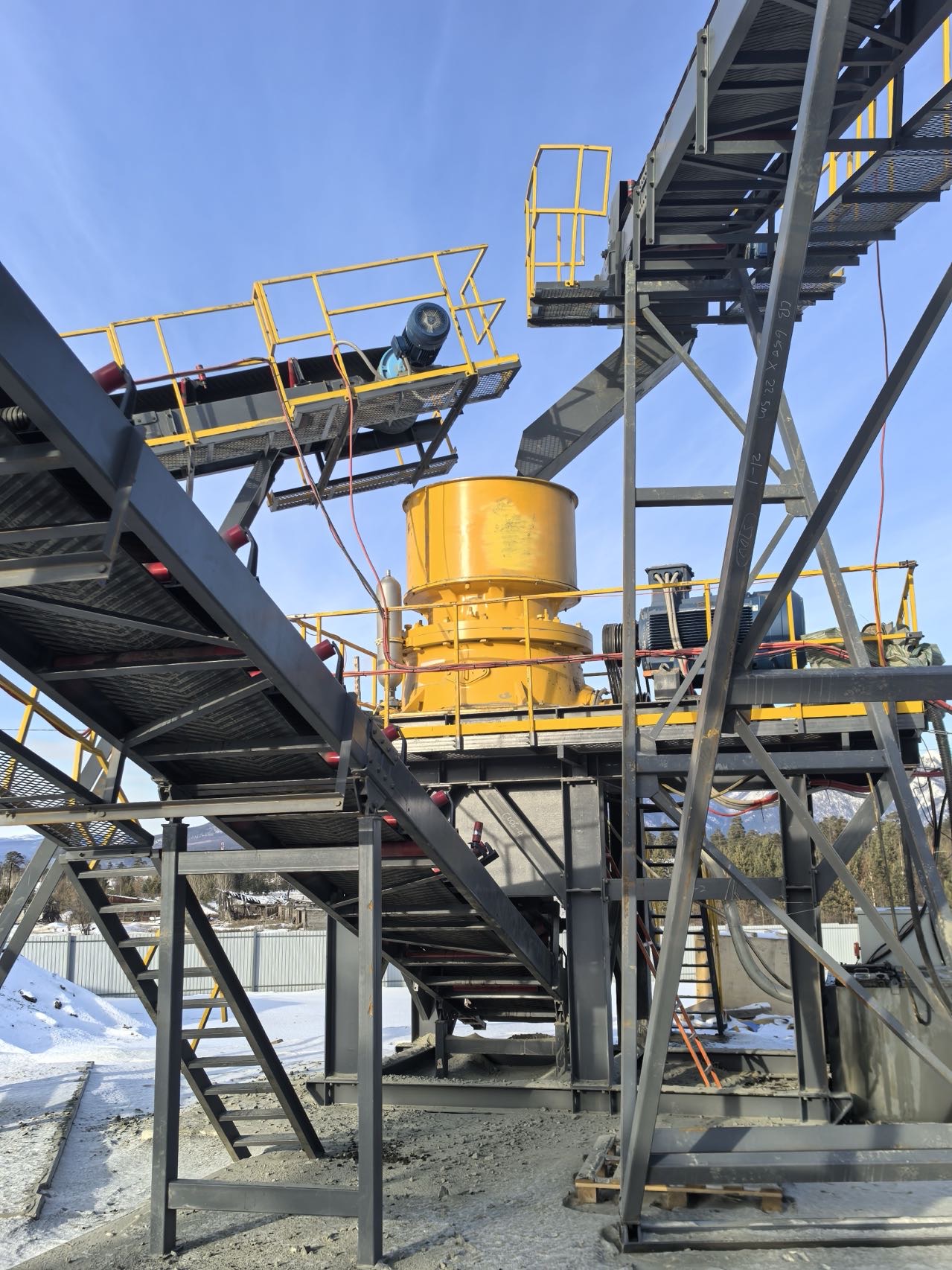
4. Case Reference: Selecting a Chinese Supplier for a Mining Project
A practical example illustrates the decision process. A mining operator in Russia required equipment for producing concrete aggregate for infrastructure and real estate projects. The initial consideration included both local and international suppliers.
The client's core requirements were: a production capacity exceeding 250t/h, compliance with environmental standards, and a need for a complete, integrated production line solution. After applying the 3-step model, the client selected Henan Centbro Machinery (STM) Equipment Co., Ltd.
Project Outcome & STM's Demonstrated Advantages
- Customized EPC Solution: STM provided a complete stone crushing and grinding production line tailored to the client's specific ore characteristics and site layout, moving beyond a simple equipment sale.
- Cost-Effectiveness: The overall project investment was approximately 10% lower than comparable international quotes, while meeting all technical performance benchmarks.
- Rapid Deployment: Leveraging a standard lead time of 30 days and efficient logistics, the equipment was delivered and commissioned within the projected timeline, minimizing project start-up delays.
- Performance Result: The installed line, which included jaw crushers and cone crushers, achieved an output that exceeded customer expectations. The finished product met industry requirements, and the production process complied with environmental regulations.
Conclusion: Aligning Procurement with Value
The crusher procurement landscape offers clear trade-offs. Mobile equipment provides flexibility at a higher operational cost, while stationary plants offer efficiency for long-term, high-volume projects. Similarly, Chinese manufacturers like STM present compelling value through cost-competitive, customizable solutions and rapid delivery, suitable for projects where total cost control and adaptability are paramount. International brands offer premium technology and unmatched global service networks.
The key for procurement professionals is to rigorously apply a scenario-based, TCO-focused decision model. As demonstrated in the Russian case, this approach can successfully identify suppliers whose strengths—such as integrated EPC capability, energy efficiency, and responsive service—directly address the project's core technical and commercial requirements.
For a detailed technical overview of crusher specifications and production line configurations, you can download the company brochure: STM Crusher Equipment Brochure (PDF).